Screen Time Done Well: Choosing and Sharing Media With Young Kids
Pediatric guidance focuses on what children watch and who they watch with. Here is how to make screen time more about connection.
By The Spark Six team
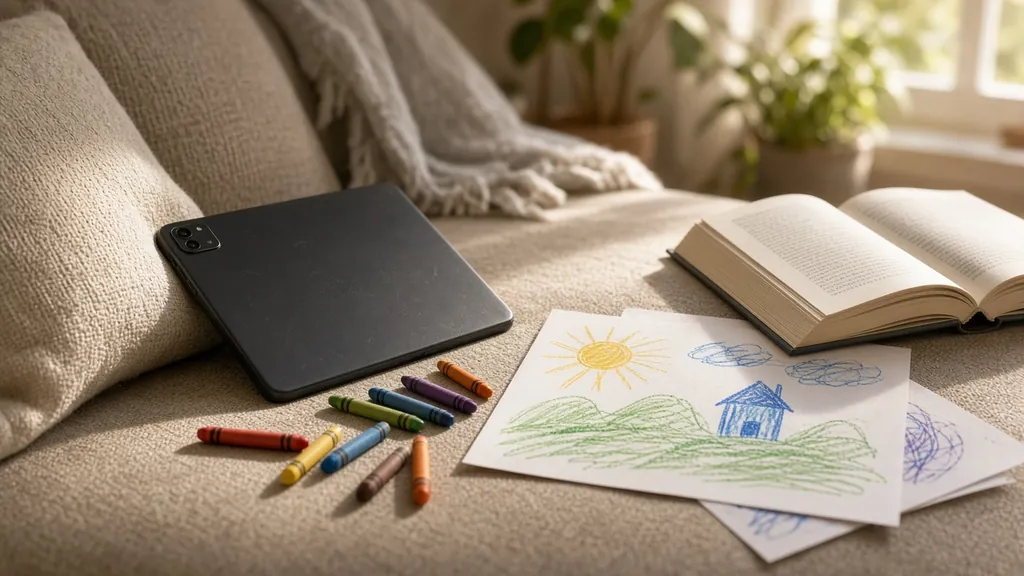
Most families with young children use screens in some way, whether it's a video call with grandparents or a favorite show. Rather than all-or-nothing, pediatric guidance focuses on choosing well and sharing screen time together. Here is a practical guide.
What pediatricians recommend
The American Academy of Pediatrics' policy statement “Media and Young Minds” reviews research on television, videos and interactive media for children up to age 5 [1]. It encourages families to think not only about time limits and content, but also about the importance of using media together, and about leaving time for other activities that matter for young children [1].
For specific age-by-age guidance, the AAP's policy statement is the place to look [1]. Families can also build their own plan with the AAP's free Family Media Plan tool [2].
Watch together when you can
Shared viewing turns a show into a conversation. Pause and ask what your child noticed, connect what they saw to real life, and try out ideas afterward. The AAP highlights parent–child shared media use as an important part of healthy family media habits [1].
A short science video can become a starting point: watch, then go and test the idea together in the kitchen or garden.
What makes media more “educational”?
Plenty of apps and shows call themselves educational. A team of learning scientists led by Kathy Hirsh-Pasek reviewed what makes children's apps genuinely support learning [3]. They point to four pillars from the science of learning: children learn best when they are actively involved (thinking, not just tapping), engaged with the learning goal (not distracted by bells and whistles), when the content is meaningful and connects to their lives, and when it is socially interactive [3].
You can use these as a quick checklist:
- Active: Is my child thinking, or just swiping?
- Engaged: Do the extras support the story, or distract from it?
- Meaningful: Does it connect to things in my child's world?
- Social: Can we talk about it together, during or after?
Don't forget the off-screen side
Screens aren't the only “tech” that can crowd out conversation. In a study of parents playing with infants, Anna Sosa found that play with electronic toys was linked to fewer adult words and fewer back-and-forth conversational turns than play with books or traditional toys [4]. Simple toys, books and chat still play a special role.
Practical tips for families
- Preview first. Watch a few minutes before your child does.
- Choose calm over loud. Gentle pacing makes it easier to talk and think.
- Turn off autoplay where possible. Decide together when the show ends.
- Pair screen with real life. After a show about bubbles, blow some bubbles.
- Use the parent tools. Many platforms have settings that let grown-ups choose what plays.
- Make a plan together. The AAP Family Media Plan helps you set family rules that fit your home [2].
How we design The Spark Six
We built The Spark Six with these ideas in mind. Our site has no ads and no tracking, and videos load only after a grown-up says yes. Every episode asks one question and ends with a single true fact that families can test together. Our read-aloud stories, such as The Tallest Trees, are designed to be read on paper or listened to together, then talked about.
The big idea
Good screen time is chosen, shared and connected to real life. Watch together when you can, talk about what you see, and then go and explore the world off-screen. Find the latest Shorts on the home page and our stories on the Stories page.
This week, try
- Watch one show together and pause once to ask, “What do you think will happen?”
- Turn one show into a real-life activity, like blowing bubbles after a bubble episode.
- Sit down as a family and start your own media plan with the AAP's free tool.
Common questions
Is video-chatting with grandparents screen time?
It uses a screen, but it's a very social activity, with real back-and-forth conversation. Many families treat video calls with loved ones differently from watching shows. Talk about it when you make your family media plan [2].
How do I end screen time without a meltdown?
Give a warning before the end (“two more minutes, then we turn it off”), choose shows with a clear ending, and have the next activity ready. A predictable routine helps.
What should I look for in a children's show or app?
Look for calm pacing, a clear learning goal, and chances to think and talk. Researchers suggest checking whether media helps children be active, engaged, make meaningful connections and interact socially [3].