Gravity for Kids: Why an Apple and a Feather Fall Differently (and When They Don't)
Gravity pulls on both. Air makes the difference. Here is how to explain it simply, plus a two-sheet-of-paper experiment to try.
By The Spark Six team
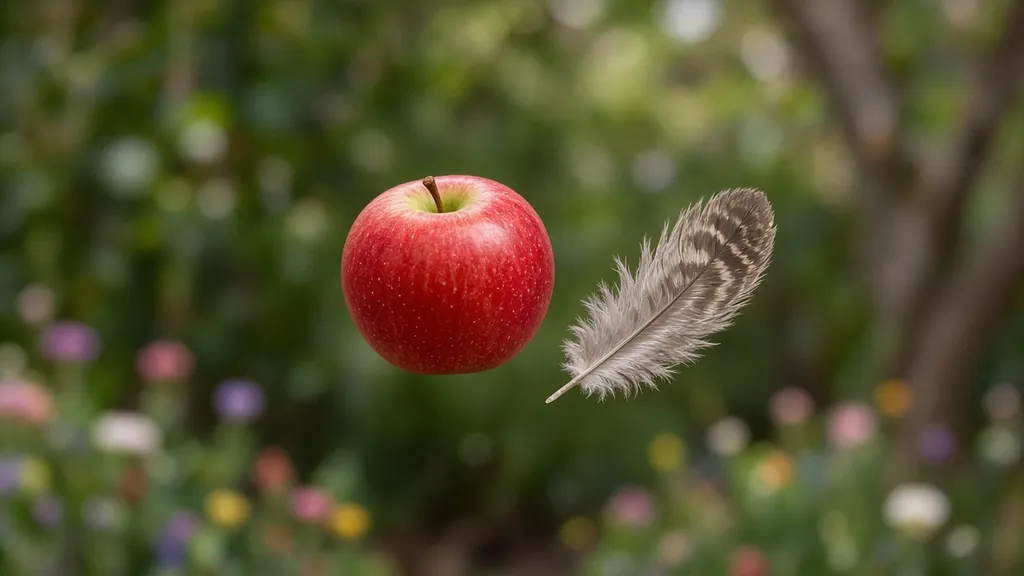
Drop an apple and a feather at the same moment and you already know what happens. The apple thumps to the ground. The feather drifts, swirls and floats down much more slowly. So does gravity pull harder on heavy things? The answer surprises many grown-ups too.
What is gravity?
NASA's Space Place describes gravity as the force by which a planet or other body draws objects toward its center [1]. It's why things fall down, why we stay on the ground, and why the planets keep moving around the Sun [1].
On Earth, gravity pulls everything downward: apples, feathers, balls and people.
So why does the feather fall slowly?
Here on Earth, falling objects are moving through air. NASA's Glenn Research Center explains that an object falling through the atmosphere feels two forces: its weight, from gravity, and the drag of the air pushing back as it moves [2]. As an object speeds up, drag grows until it can balance the weight. Then the object stops speeding up and falls at a steady speed, called its terminal velocity [2].
A feather is very light and spread out, so the air slows it down a lot and it reaches its slow, gentle falling speed almost immediately. An apple is compact and heavier for its size, so air slows it much less. That is why, in air, the feather falls more slowly than the apple.
What if there were no air?
This is where it gets exciting. In 1971, at the end of the Apollo 15 mission, astronaut David Scott stood on the Moon and dropped a hammer and a feather at the same time. Because the Moon has essentially no air, there was no air resistance, and the feather fell at the same rate as the hammer [3]. They hit the ground together.
NASA notes that this matches what Galileo had concluded hundreds of years earlier: objects released together fall at the same rate, regardless of mass, when nothing else gets in the way [3].
So the simple version for kids is:
- Gravity pulls on everything.
- Air pushes back on falling things, and it slows light, spread-out things the most.
- Without air, an apple and a feather fall together.
Try it: the two-paper test
You can see the same idea at home, safely, with two sheets of paper.
- Take two identical sheets of paper. They weigh the same.
- Crumple one into a tight ball. Keep the other flat.
- Hold them at the same height and drop them at the same moment.
- Watch: the ball lands first, and the flat sheet floats down.
- Now crumple the second sheet too, and drop them again. They land together.
Same weight, same gravity. The only change was how much air each sheet had to push through. This is exactly the test Zeena and Kiana do in our story Why Do Things Fall Down?.
Questions to wonder about together
- Why does a parachute make a toy land gently? (It catches lots of air.)
- What would happen if you dropped two balls of different sizes?
- Why do you think astronauts had to test this on the Moon instead of in a room on Earth?
A note on safety
Keep falling experiments small and soft: paper, feathers, socks, balls. Never drop things from high places, and don't stand on furniture to get extra height. A child's own arm height is plenty.
The big idea
Gravity is working every second of every day, pulling things toward the ground. Air is what makes a feather's ride slow and gentle. Once your child sees the two-paper test, they will never look at a falling leaf the same way again.
Read Zeena's full gravity adventure in our Rocket Lab stories.
This week, try
- Do the two-paper test, then let your child teach it to another family member.
- Make a handkerchief parachute for a small toy and drop it from arm height.
- Watch leaves or feathers fall outside and talk about which fall fastest, and why.
Common questions
Does gravity pull harder on heavier things?
Heavier objects do weigh more, but without air in the way, heavy and light objects released together fall at the same rate. That's what the hammer-and-feather drop on the Moon showed [3]. On Earth, air is what makes light, spread-out things like feathers fall slowly.
Why don't we float away?
Earth's gravity pulls us toward the center of the planet, so our feet stay on the ground [1]. When you jump, gravity pulls you back down.
How does a parachute work?
A parachute catches a lot of air. Gravity still pulls it down, but the air pushing back (drag) slows it so it falls gently [2]. You can test this with a small toy and a handkerchief parachute, dropped from arm height.