How Do Penguins Stay Warm? Feathers, Fat and the Famous Huddle
Emperor penguins breed on the sea ice in the coldest season on Earth. Here is how they stay warm, explained simply.
By The Spark Six team
Imagine standing outside all winter in Antarctica, with no coat, no house and freezing winds. That is daily life for emperor penguins. How do they do it? The answer is a clever mix of feathers, fat and teamwork.
Meet the emperor penguin
National Geographic notes that emperors are the largest of all penguins, with an average bird standing around 45 inches tall [1]. They live on the Antarctic ice and in the icy waters around it, where wind chills can reach -76°F [1].
The Australian Antarctic Division adds an amazing fact: emperor penguins don't just survive the Antarctic winter, they breed during it, in the worst weather of the year [2].
Trick 1: a thick coat of feathers
Penguin feathers are not like a fluffy pillow. They are small, stiff and packed very tightly. The Australian Antarctic Division describes several layers of scale-like feathers, and notes it takes very strong winds, over about 110 kilometers per hour, to ruffle them [2].
A study of emperor penguin feathers by Cassondra Williams and colleagues explains that the birds' ability to keep their bodies warm in these conditions is due in large part to their feathered coat [3]. Penguins have been reported to have the highest feather density of any bird [3].
A simple way to explain this to kids: the feathers work like a sleeping bag, trapping warm air close to the body and keeping wind and water out.
Trick 2: a layer of body fat
Emperor penguins also carry large reserves of body fat, which store energy for the long winter [2]. Fat under the skin also helps hold warmth inside the body, a bit like a warm blanket.
Trick 3: the huddle
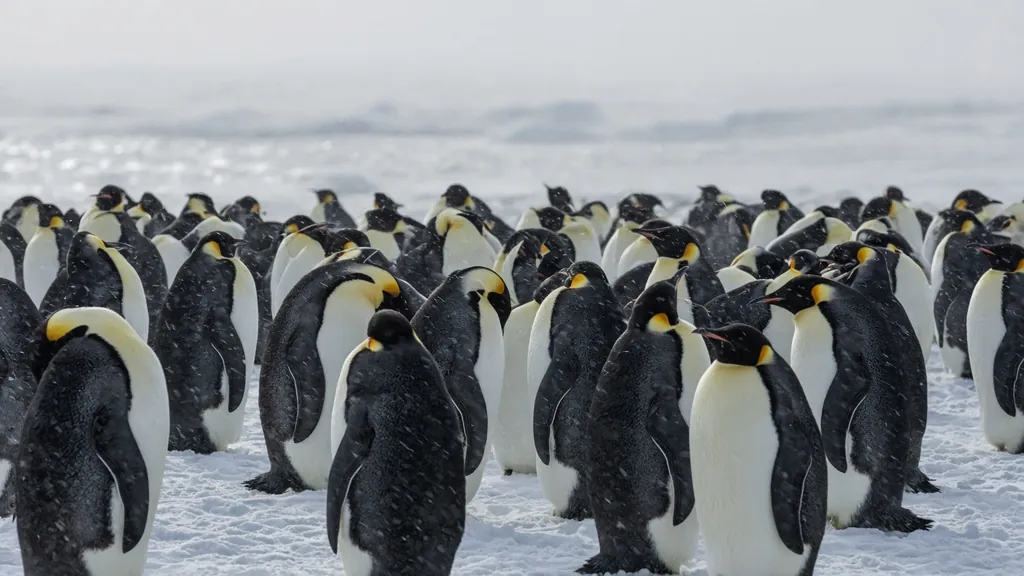
When the wind howls, emperor penguins pack together in a tight group called a huddle. National Geographic explains that they huddle to escape the wind and conserve warmth, taking turns moving into the warmer middle and then back out to the edge [1].
Scientists have studied huddles closely. Caroline Gilbert and colleagues attached small data loggers to penguins' feathers and found that huddling was shorter and more on-and-off than people once thought, and that birds had equal access to the warmth of the huddle [4].
Another team, led by Daniel Zitterbart, filmed huddles and discovered something remarkable. Every 30 to 60 seconds, all the penguins take tiny steps together, and these steps travel through the huddle like a wave [5]. Over time, these small moves slowly reshuffle the whole group, so each penguin gets a turn inside [5].
Try a family huddle
Here is a gentle way to feel the idea:
- On a cool day (indoors is fine), stand a little apart and notice how you feel.
- Now stand close together in a family huddle for a minute.
- Take tiny shuffling steps together, slowly turning the huddle, so everyone gets a turn in the middle.
- Talk about it: Who was warmest? Why?
You can also wrap a toy in a scarf and another in nothing, and talk about which one would stay cozier on a cold day.
Talk about it
- What are the three ways penguins stay warm?
- Why do you think penguins take turns in the middle?
- What do you do to stay warm on a cold day?
Read the story
In How Do Penguins Stay Warm?, Kayla leads the Spark Six to Antarctica. They watch the penguins from a safe distance and learn all three tricks: tight feathers, a layer of fat and a big friendly huddle. Find it in our Rocket Lab stories.
This week, try
- Try a family huddle with tiny shuffling steps, and talk about who felt warmest.
- Wrap one toy in a scarf and leave another bare, and talk about which would stay cozier outside.
- Find Antarctica on a globe or map and talk about why it's so cold there.
Common questions
Do penguins' feet get cold?
Their feet stand on ice for long periods, but penguins have bodies built for the cold, and they keep moving and shuffling. In a huddle, they take tiny steps together that slowly move the whole group [5].
Are all penguins found in snowy places?
No. Emperor penguins live on the Antarctic ice [1], but other kinds of penguins live in milder places too. It's a fun one to look up together with a map.
Why do penguins take turns in the middle?
The middle of the huddle is warmest and the edge is coldest. Penguins move between the edge and the middle over time, so each bird gets a turn to warm up [1].